A Reading tool. Not a chatbot.
Amira is purpose-built for the classroom.
Amira assesses reading, delivers one-to-one tutoring, and turns student evidence into actionable insight for teachers. This is not open-ended AI: what Amira can and cannot do with a student is fixed, inspectable, and identical in every classroom in your district. That is not a policy we wrote. It is how the product is built.
What Amira does
- Judges the reading, not the childA reading decision, not a judgement: Speech is transcribed and matched against the passage a student was given. The output is a decision about a single phoneme, not a judgement about the student.
- Selects from a fixed set of pre-written promptsInspectable before use: Every prompt a student hears is drawn from a reviewed instructional set your team can inspect in full before a single student uses it. Nothing is written on the fly.
- Hands the decision to a teacherTeacher-gated: Grouping, placement and intervention change only when a teacher chooses to change them. Amira proposes. Then Amira stops.
- Listens only to the passageBounded capture: Capture begins when the reading passage starts and ends when it ends. The reading is the only things Amira ever hears.
What Amira WILL NEVER DO
- Generate open-ended language to a childDesigned out: No free text is ever produced to a student, in either direction. There is no chat window anywhere in the product.
- Hold a conversationNot possible: A student cannot ask Amira anything unscripted, and Amira cannot ask a student anything that is not written and reviewed in advance by our reading specialists.
- Build a voiceprintNever derived: No biometric identifier is created from a student’s voice. Amira never produces a voiceprint, a voice profile, or any other biometric identifier.
- Listen in the background No always-on mic: There is no ambient capture and no always-on microphone anywhere in the product. When a passage ends, Amira is not listening.
Reviewed by experts. Proven across systems.
Twelve published reviews. Each with its own rigorous evaluation
- Louisiana public schoolsHigh-use Amira first graders outperform non-users.
- Utah State Board of EducationKindergarteners using Amira with fidelity surpass the control group.
- Georgia CPRE studyHigh-usage students excel in reading fluency.
- Carnegie Mellon UniversityGrade 3 students show major word comprehension gains.
- University of British ColumbiaSignificant grade level reading gains with Amira.
- DePaul UniversityAmira tutoring greatly improves reading fluency.
- Carnegie Mellon UniversityAmira tutoring dramatically boosts word identification.
The reading screener is approved in 40+ states and top-rated by NCII for risk screening.
-
The Northern Ireland Department of Education partnered on literacy, and the suite is running across Latin America and the Caribbean.
-
Canadian districts run on Canadian infrastructure, with their own staff and student sign-in.
- The research
- Data, privacy and security
The core coherence learning loop.
Assess, Instruct, and Tutor are one connected cycle, not three separate tools. Assessment reveals what each student needs. Instruct turns that evidence into the next move, with Studio built in, so teachers can build and adapt lessons themselves, all on the same student evidence. Tutor delivers targeted practice, then sends fresh evidence back into the loop. The result is one continuous loop that extends your ELA vision instead of competing with it.
One system. One student story. One source of truth. One roster. One sign-on. One connected view across assessment, instruction, and practice. Amira turns connected evidence into faster decisions, more targeted instruction, and a clearer path to student growth. Less time connecting systems. More time improving outcomes.
How a session moves through the system.
Students read aloud from text matched to the purpose, whether selected by the assessment, chosen by the student, or aligned to classroom instruction. Amira listens and analyzes in real time.
Because the reading is happening live rather than being marked afterwards, a single session captures around ten times the measurement points of a traditional assessment. And to the student, it feels like practice, not a test.
Amira identifies not that a word was wrong, but which sound, and whether it's a pattern in the reading.
Amira analyzes reading down to the phoneme: which sound inside which word broke down, and whether that same sound has been slipping all week. It separates substitutions, omissions, insertions, and prosody, so an accent or a dialect reads as a voice, never as a deficit. One missed word is a moment. The same sound missed for a week is the thing you actually want to see.
Amira provides in-the-moment feedback using pre-written prompts based on Science of Reading.
The support is grounded in what the child actually said, not a generic hint that misses the source of the struggle. Each response comes from a carefully designed set of instructional prompts rather than being generated on the spot.The goal is to give the student just enough support to stay in the text: accurate enough to move forward, but challenging enough to keep the thinking and reading work in the student’s hands.
The teacher receives a clear view of the session, the patterns identified, and recommended next steps. From there, the teacher decides what happens next.
What comes back is more than a report. Amira turns what happened during the session into student groupings, a recommended lesson pathway, and an estimate of the instructional time each student may need to reach mastery.Amira recommends. Teachers decide. Every grouping, lesson, and next step remains in the teacher’s hands. Nothing changes in instruction unless the teacher chooses it.
Nothing is composed at the moment of delivery. The instructional set is fixed, reviewed and inspectable before deployment.
Trust Starts with Transparency
You should know what happens to student data.
Get answers to your most pressing questions and explore the Amira Trust Center to understand our best practices in data, privacy and security.
In your region, in Amira's own facilities, and nowhere else. Voice recordings are stored only in Amira's data facilities: Ohio for United States students, Montreal for Canadian students, with Canadian sign-in kept in country. Storage never leaves Amira's direct control. Every recording is de-identified, never linked to an individual student, and encrypted in transit and at rest with the same technology major banks use. Amira runs on a single audio subprocessor, the data-center operator, which is contractually barred from accessing, copying, or using the files, and even if it tried, the encryption makes them unreadable.
Your district does. Audio is retained only as long as needed to support the educational service, with district-level options for shorter retention or no stored audio at all. Districts can also request deletion at any time.
Student data remains under the district's control. At the end of the agreement, Amira deletes student data in accordance with the district's agreement and applicable retention requirements. Districts may also request deletion or transfer of student data before then.
Almost no one, and all of it is in writing. Amira uses one subprocessor, the data center, and it is contractually barred from touching the files. Student data is never sold, never shared with any commercial third party, and has never been given to the federal government. These are not promises on a web page. They are contractual commitments to more than 2,000 government agencies, backed by three independent annual audits (financial, security, and contract compliance), SOC 2 certification, and substantial cyber-liability insurance. Amira is FERPA and COPPA compliant, 1EdTech TrustEd certified, a CISA Secure by Design signatory, and CSA STAR Level 1, each one independently verified or publicly listed, not self-declared.
[Built against WCAG 2.1 AA and Section 508, with a conformance report based on VPAT 2.4 available on request. Accessibility owner to confirm whether a conformance level can be stated outright.]
Nothing here matches that. The Trust Center holds the full documents, and trust@amiralearning.com answers the rest.
- Never Model training Amira does not use voice recordings directly to train models. We do not provide student data to others to build models. Amira utilizes only de-identified data to train our models. Participation in model improvement is a separate district setting from audio retention: turning retention off does not by itself decline model improvement, and declining it does not change the audio setting.
- Never Biometrics No biometric identifier is created from a student’s voice. Amira never produces a voiceprint, a voice profile, or any other biometric identifier.
Developed from the Science of Reading. Built for the classroom.
-
Origin
Carnegie Mellon, Project LISTEN research
Where does it come from?
A decade of research at Carnegie Mellon University’s Project LISTEN. Amira is built on a model of how the reading brain turns print into sound, not a bank of items pitched to produce a score.
Source: [paper, linked] -
Construct validity
Validated where it matters: against real reading outcomes
Does it measure what it claims to measure?
The assessment is designed so its parts work together to measure the same underlying construct: reading ability. Its scores also align with and predict performance on established measures such as TPRI, ITBS, and STAAR.
Source: [technical manual, needs publishing]
In other words, it is not measuring something that merely relates to reading. It is measuring reading itself. -
Reliability
Consistent scores, documented across the full year
Can educators trust the score enough to act on it?
Reliability shows whether a student’s score is consistent, repeatable and dependable over time. Amira documents both internal consistency and test–retest reliability, including how scores perform from fall through spring.
Source: [technical manual, needs publishing]
The result is a score educators can use with confidence, because its stability is demonstrated in the evidence rather than simply claimed. -
Fairness across dialect and accent
96% agreement with expert human scorers, on par with trained human raters
Does the system mistake an accent or dialect for a reading error?
Speech recognition has a documented history of uneven performance across accents and dialects, so evidence matters. Amira has it:
NCII Academic Screening Tools Chart (assessment agreement, correlation, and bias study). Reading Error Detection figure reported by Amira.
Amira’s assessment scoring shows 96% item-level agreement with expert human raters, matching the 96–97% agreement human scorers reach with one another. Overall score agreement rises to a 0.95–0.98 correlation.
Tutor is built on the same principle. Amira’s Reading Error Detection model is designed to distinguish true reading errors from natural variation in accent, dialect, pronunciation, and developing speech, also reaching 96% agreement with expert scoring. Fairness is tested at the item level, too. Across 2,598 items and 65,000 students, only about 0.2% showed meaningful group differences and were removed.
The goal is simple: measure reading skill, not the way a child sounds. -
Coverage
From foundational skills to comprehension
How much of reading does it actually see?
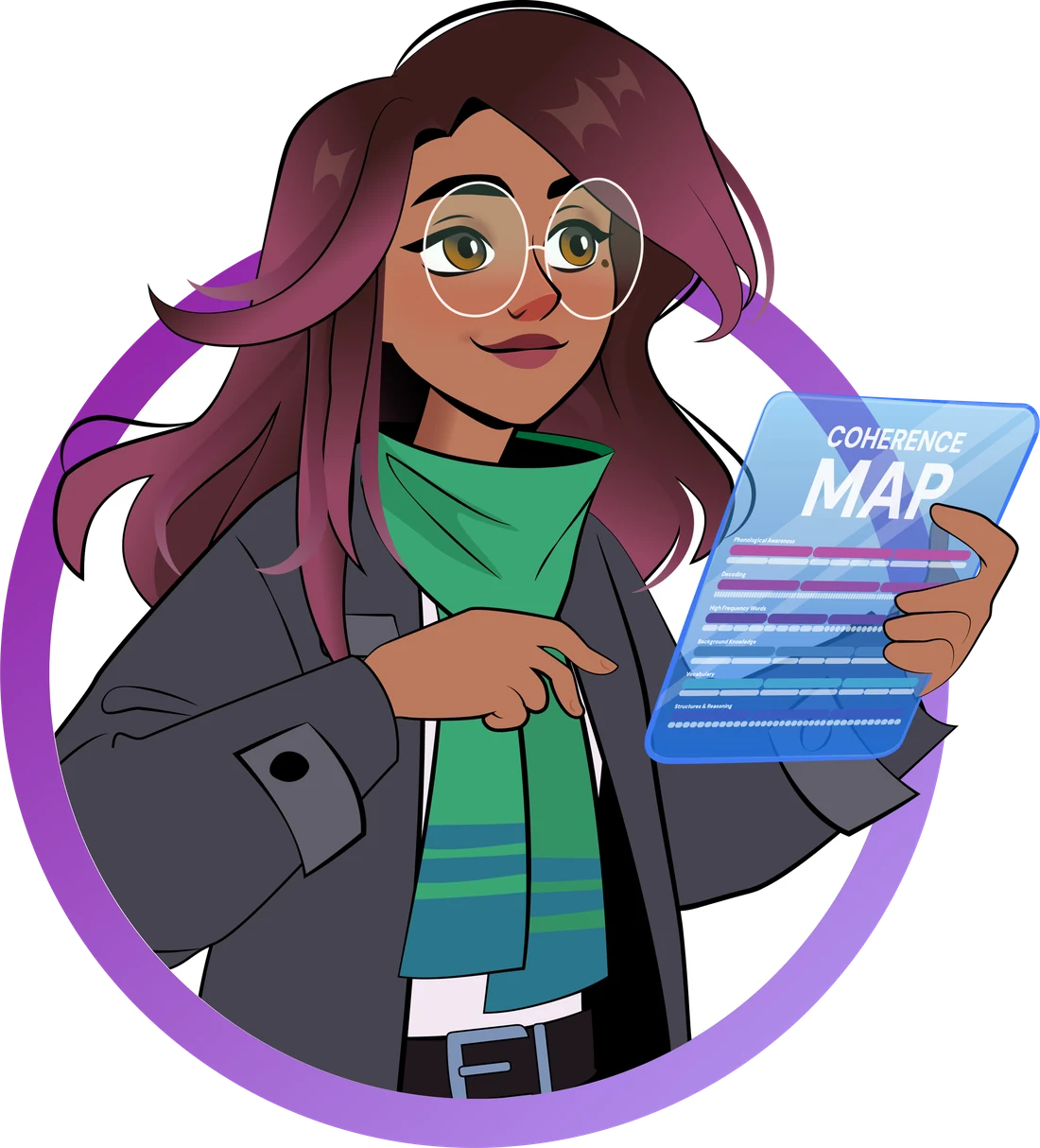
Reading is not a single skill, and a meaningful assessment should not reduce it to one measure. Amira looks across the full reading process, including foundational skills, word recognition, fluency, vocabulary and comprehension, to build a more complete picture of what a student can do.
Source: [product documentation]
That broader view helps educators see not only whether a student is struggling, but where the breakdown is happening and what they are ready to learn next.
Because the more of reading you can see, the more precisely you can respond.
What implementation actually takes
No hidden lift. No months-long implementation maze. Three focused conversations get the right people aligned and your district ready to go.
ONE-TIME SETUP
-
District IT
- RosteringConnect through Clever, ClassLink, or OneRoster 1.0/1.1. If your district does not use a rostering system, Amira also supports CSV import or SFTP. We confirm student IDs and campus codes up front so launch is clean.
- Sign-onUse the systems your schools already know, including Clever, ClassLink LaunchPad, Google Classroom, Schoology, SAML, or LTI.
- BandwidthPlan for approximately 10 Mbps download and upload for each device actively using Amira.
-
The school
- Devices and headsetsAmira runs on Chromebooks, Windows and Mac devices, and iPads, with a current browser and at least 4 GB of memory. Headsets are optional. If used, we recommend a boom microphone without inline controls.
-
Amira
- Professional developmentTeachers and leaders have access to Amira Academy, the Teacher Resource Hub, and the Champions community, with Customer Success helping your district build the right launch plan.
- SupportA dedicated Customer Success Manager stays with your district from planning through implementation and beyond, with responsive technical support when you need it.
The opportunity for students to produce and read and get feedback, and to do that daily. This has been monumentally impactful for improving reading scores across our district.Kim CallisonAssistant Superintendent for Teaching and Learning
Lubbock Independent School District, Texas


Hi, I’m Amira.
I listen to a child read, help in the moment, and hand every decision back to the teacher.